Where Your Container or Tiny Home Belongs
Buying the home is one decision. Where it lives is another. This guide covers land selection, zoning, community living, utility planning, and the investment case for tiny and container homes.
Editorial Note: Some links on this site are affiliate links — we may earn a commission if you purchase or sign up through them, at no additional cost to you. Affiliate status never determines what we include or how we evaluate it. View current program status → Separately, zoning laws and investment returns vary significantly by location; nothing here constitutes legal, financial, or planning advice.


Land sorted? Off-grid power and setup tools are next.
See ResourcesWhat to check before you buy any parcel
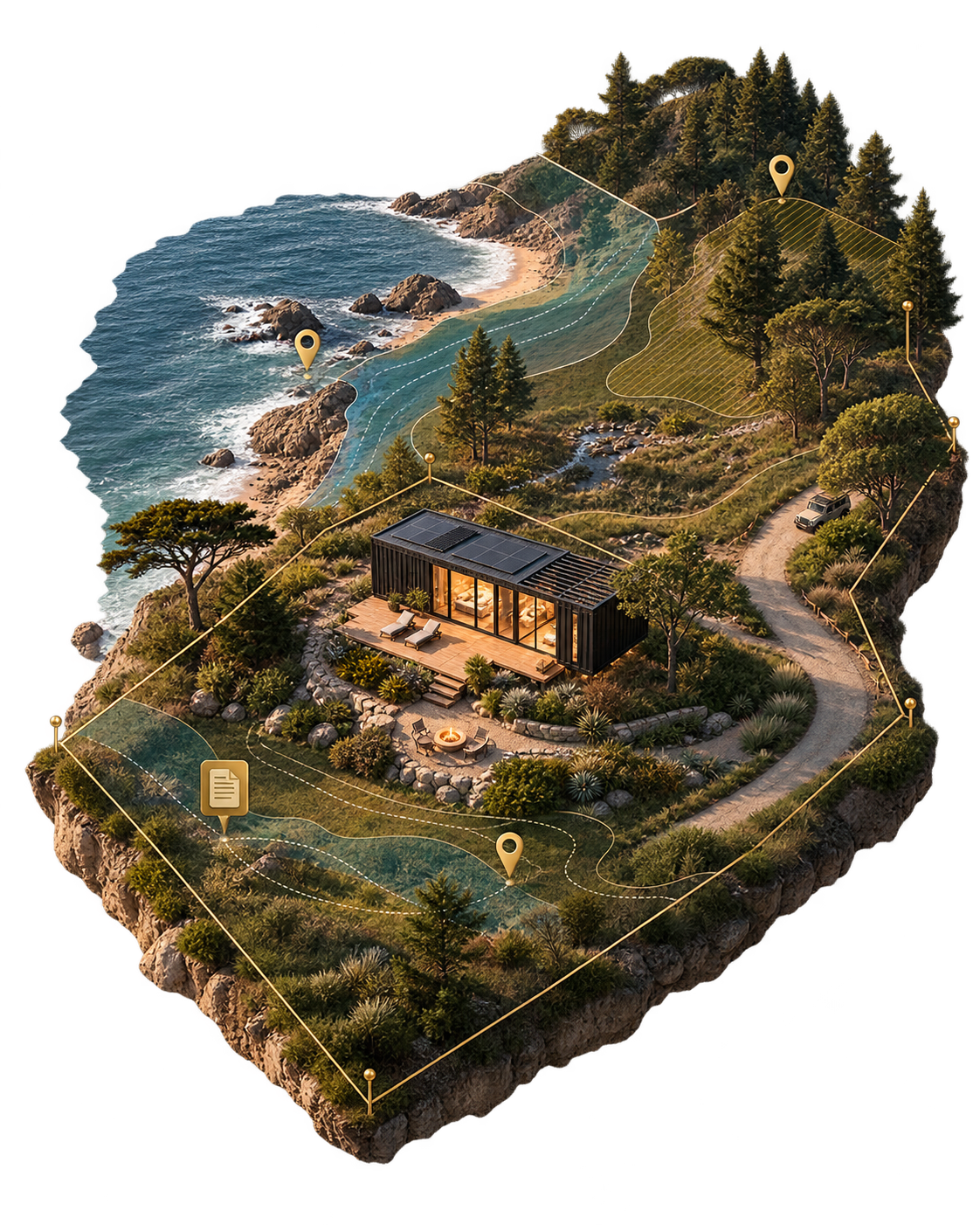
Buying land for a tiny home or container home is not the same as buying land for a traditional build. The considerations overlap but the priorities differ. Zoning is the most important thing to verify, and it must be verified before anything else.
In many parts of the country, rural agricultural land looks like a perfect, affordable canvas for a tiny home, but is actually zoned in a way that prohibits permanent or semi-permanent residential use. Some counties have minimum square footage requirements for dwellings that effectively exclude tiny homes entirely. Others have embraced tiny homes with specific ordinances that streamline approval. You cannot tell which situation applies from the listing. You must ask the county planning department directly.
"The three questions that matter before any other: Is the parcel zoned for my intended use? Can utilities reach it affordably? Can my home be delivered to it safely?"
The land evaluation framework that saves buyers the most timeUtility Access
Land with existing utility connections — water, electricity, and sewer or septic — is worth meaningfully more than raw land without them, because the cost and complexity of adding those connections is substantial. A parcel that appears cheap may require $30,000 to $80,000 in utility development before it can support a livable home.
At minimum, research the cost of connecting to the nearest water main, the nearest electrical line, and the feasibility of a septic system given the soil conditions. In some rural areas, well water and solar power are practical alternatives that reduce dependence on utility infrastructure. In others, the terrain or soil conditions make those alternatives impractical. Know what you are working with before you make an offer. See our full off-grid utility planning guide for sourced cost ranges on wells, septic systems, and solar setups.
Road and Delivery Access
Tiny homes and container structures are large and heavy. The road leading to your placement site needs to accommodate a delivery truck with adequate clearance, turning radius, and weight tolerance. A beautiful remote parcel accessible only by a narrow, unpaved private road may be impossible to reach with a 40-foot container structure. Survey the access route yourself before committing, and discuss your specific delivery requirements with your builder to confirm feasibility.
Steep slopes and thick tree coverage can also complicate placement. Most builders can advise on minimum site preparation requirements for their specific structures — ask for that information before you purchase land with a specific home in mind.

Three ways tiny homes generate returns
Real estate investment involves risk and results vary significantly. These represent common use cases, not guarantees of outcome.
Short-Term Rental Income
In scenic, high-demand locations, container and tiny homes can perform well as short-term rentals. Their distinctive character can generate genuine curiosity and strong guest interest. A well-placed unit near a national park, mountain town, lake, or coastal area may command competitive nightly rates. The lower purchase price relative to traditional real estate may also improve potential cash-on-cash return. Local STR regulations must be verified before assuming this use is permitted.
Accessory Dwelling Unit Rental
Placing a tiny or container home on an existing residential property as a long-term rental ADU can generate steady monthly income on a structure that cost a fraction of a traditional addition. In markets with strong housing demand and limited rental supply, an ADU can meaningfully offset a primary mortgage. ADU regulations vary widely by jurisdiction — some areas actively encourage them, others restrict them significantly.
Primary Residence Cost Reduction
For many buyers, the investment thesis is simpler: eliminating or dramatically reducing housing costs. A paid-off tiny home on owned land replaces a mortgage or rent payment with a small land cost and utility costs. The capital that would otherwise go toward a conventional mortgage stays available for other investments or experiences. This is a lifestyle investment rather than a financial one, but for many people it produces the strongest real-world return.
All investment scenarios above involve risk. Returns depend on location, purchase price, market conditions, local regulations, occupancy rates, and many other factors. Past performance in similar properties does not guarantee future results. This is not financial advice.
Considering the STR route? See what it actually takes to run one.
Read the STR Feasibility GuideWhat the zoning question actually looks like
This is a simplified framework for understanding the types of zoning situations you might encounter. Actual regulations vary by specific jurisdiction. Always verify with your local planning department.
| Situation | Tiny Home on Wheels | Container Home (Permanent) | ADU on Existing Property | Short-Term Rental Use |
|---|---|---|---|---|
| Tiny Home Friendly Jurisdiction Specific ordinances in place |
Often permitted | Often permitted | Often permitted | Check local STR rules |
| Rural Agricultural Land Varies widely by county |
Varies by county | Varies by county | Not always applicable | Check local STR rules |
| Standard Single-Family Residential Typical suburban or urban lot |
Often restricted | May require variance | Increasingly permitted | Check local STR rules |
| RV Park or Campground Specifically zoned for vehicles/camping |
Usually permitted | Typically not permitted | Not applicable | Often the intended use |
| Planned Tiny Home Community Purpose-built development |
Usually permitted | Usually permitted | Not applicable | Depends on community rules |
This table is a general framework only. Every jurisdiction has its own specific rules. "Often permitted" means this is the common case, not a guarantee for your specific location. Always verify with your county or municipal planning department before purchasing. Use our zoning finder tool to jump straight to your state, or browse the states we've researched in depth: Florida, Texas, California, North Carolina, Colorado, Washington, New York, Ohio, Georgia, Oregon, Tennessee, Arizona, Virginia, Michigan, Idaho, Pennsylvania, West Virginia, Missouri, Illinois, South Carolina, Nevada, Utah, New Mexico, Kentucky, Indiana, Wisconsin, Massachusetts, and Alabama, plus New Jersey, Minnesota, Maryland, and Louisiana.
Tools worth using once you have land
There is no charge to use this comparison. Product, service, and equipment costs are set by each provider. These are the resources that come up most often once a land purchase moves from planning into execution.
| Resource | Type | Price Range | Service Area | Customization | Certification | Warranty | Financing | Best For | Advantage | Drawback | Verified |
|---|---|---|---|---|---|---|---|---|---|---|---|
| Renogy | Off-grid solar panels, batteries, kits | ~$160 (100W kit) to $2,200+ (RV/cabin kits), per company site | Ships nationwide; products designed for off-grid, mobile, and small-scale use | Kits sized from single-panel setups to full cabin systems | Not a certification per se; company founded 2010 | 25-year power-output warranty, 5-year materials warranty (per company site) | Not applicable — direct purchase | Land with no existing utility connection | Warranty and pricing are clearly published on their own site | Not designed for full residential rooftop-scale installs | July 2026 |
| Jackery | Portable power stations & foldable solar panels | ~$1,300 average order value, per third-party affiliate program data; individual units range widely by capacity | Ships nationwide | Explorer power stations pair with SolarSaga panels in various bundle sizes | Not a certification per se; company founded 2012 in California | Warranty terms not independently verified; confirm directly with Jackery | Not applicable — direct purchase | Off-grid buyers wanting portable, plug-and-play power rather than a fixed installation | One of the most recognized brands in portable power; genuinely off-grid-focused positioning | Portable stations suit essential loads, not a full off-grid homestead's total power draw | July 2026 |
| LandWatch | Land search platform (editorial link, not monetized) | Free for buyers to browse; sellers pay for listings | Nationwide | Filter by location, price, parcel size, and property type | Not applicable | Not applicable | Not applicable | Buyers actively searching for rural or off-grid-suitable parcels | Owned by CoStar; one of the larger, more established land marketplaces | As a marketplace, listing quality and pricing accuracy vary by individual seller | July 2026 |
| Hostaway | Short-term rental channel management software | Pricing not published; third-party estimates suggest roughly $50/property/month plus possible commission-based tiers | Nationwide / cloud-based | Custom quote scaled to portfolio size | Not applicable | Not applicable (software, not a physical product) | Not applicable | Buyers planning to run their home as a short-term rental | Syncs across 200+ booking channels including Airbnb, Vrbo, and Booking.com | Built for professional multi-property managers; may be more than a single-home owner needs | July 2026 |
Sourced from each company's own website as of July 2026, with third-party reviews noted where the company doesn't publish pricing directly. Prices, terms, and warranty coverage are set by each company and change without notice to us — confirm current details directly before making a decision. See our Research Methodology for how we compile this table.
Renogy
According to the company's site, Renogy kits for cabins and small off-grid homes range from roughly $160 for a basic 100W panel kit up to $2,200 and above for larger RV and cabin solutions, with a 25-year power-output warranty and 5-year materials warranty standard across their panels. Renogy was founded in 2010 and is designed primarily for off-grid, mobile, and small-scale use rather than full residential rooftop installs. Read our full review, including some real customer complaints worth knowing about.
Shop Renogy Solar Kits →Kits are sized from small cabins to full off-grid homesteads, with sizing guides to help you match panels and battery capacity to your actual load.
Jackery
Founded in California in 2012, Jackery is one of the most recognized names in portable power stations, built for exactly the off-grid, outdoor, and van-life use cases this site covers. According to the company's own site, their Explorer power stations and SolarSaga foldable panels are positioned for home backup, RV and van life, camping, and remote work — a more direct off-grid fit than a grid-tie-focused catalog. Average order value runs around $1,300, per third-party affiliate program reviews. Read our full review for what real customer feedback says.
Explore Jackery Power Stations →A strong complement to Renogy — Jackery's strength is portable, plug-and-play power stations rather than fixed panel installations.
LandWatch
LandWatch is owned by CoStar, which also owns Lands of America and Land And Farm, and is one of the more established land marketplaces for rural, recreational, and off-grid-suitable parcels. It's free for buyers to search and filter by location, price, and parcel size; sellers pay for listings. As with any marketplace, listing accuracy and pricing depend on the individual seller, not the platform. Read our full review for real complaint patterns worth knowing before you rely on any single listing.
Search Land on LandWatch →Included here as a genuinely useful search tool, not because we currently earn from it.
Hostaway
If you're placing your home as a short-term rental, Hostaway syncs your calendar across 200+ booking channels, including Airbnb, Vrbo, and Booking.com, from one dashboard. Worth knowing: Hostaway doesn't publish pricing publicly and is built primarily for professional operators managing multiple properties, so it may be more tool than a single-home owner strictly needs — request a quote to see if it fits your scale. Read our full review for real pricing ranges and customer feedback.
Explore Hostaway → Affiliate link — we may earn a commissionUseful once your home is built and ready to list, not before.
Land Evaluation Checklist for Tiny Home Buyers
Seven things to verify before purchasing any parcel for a tiny home or container home placement.
Confirm zoning classification with the local planning department
Do not rely on the listing description. Contact the county or municipal planning department directly and ask whether your intended use is permitted on this specific parcel. Get the answer in writing if at all possible.
Research utility access and connection costs
Ask what utilities currently reach the parcel and what the estimated cost is to connect those that do not. Water, electricity, and sewer or septic are the three critical items. Get at least two contractor estimates for any utility work required.
Drive the access road and assess delivery feasibility
Walk or drive the entire route from the nearest paved road to your intended placement site. Note any low clearances, tight turns, steep grades, or soft ground that might prevent delivery of a full-size home structure. Share your assessment with your builder before committing to a specific home.
Check for deed restrictions, HOA rules, or easements
Some parcels have deed restrictions that limit their use in ways that zoning alone does not capture. HOA rules can also be more restrictive than local zoning. Review the title report and any recorded restrictions on the property before making an offer.
Assess the soil conditions for your intended foundation type
Different foundation approaches require different soil conditions. Soft, expansive, or poorly draining soil can complicate or significantly increase the cost of foundation work. A soil test is worthwhile for any parcel where you plan a permanent placement.
Verify short-term rental regulations if that is your intended use
If you are purchasing land to operate a short-term rental, research the specific STR regulations for your jurisdiction before you commit. Some counties and municipalities have enacted restrictions or outright bans on short-term rentals in recent years. The regulatory environment continues to evolve.
Have a real estate attorney review the purchase contract
Land purchases have their own set of legal considerations distinct from those in a traditional home purchase. An attorney familiar with land transactions in your state can identify issues in a purchase contract that would not be obvious to a buyer making their first land purchase.
What people get wrong about tiny home placement
These misconceptions consistently catch buyers off guard. Worth reading before you fall in love with a specific location.
Land ownership does not override zoning law. Your right to use your land is always constrained by the local zoning code, which specifies what types of structures are permitted, minimum size requirements, setbacks from property lines, and many other conditions. In some jurisdictions tiny homes are explicitly welcomed. In others they are effectively prohibited regardless of land ownership. Always verify before assuming.
Rural land is often less expensive and zoning may be more permissive, but utility access is typically far more complex and costly outside town limits. Connecting to water, electricity, and sewer in a rural area can easily cost more than the land itself. Solar power, well water, and septic systems are viable in many rural contexts, but their feasibility depends on terrain, sunlight exposure, water table depth, and soil conditions — all of which vary by specific parcel.
Location is the dominant factor in short-term rental returns, and a distinctive structure in a low-demand area will not outperform a mediocre structure in a high-demand one. The communities with the strongest STR performance for container and tiny homes tend to be within a few hours of major population centers, adjacent to strong natural attractions, or in established vacation destinations. Market saturation, local STR regulations, and seasonality all affect actual earnings significantly. Results vary widely.
Property and placement questions answered
Still looking for the right home?
Luxe Box Homes covers the builder side of the equation: a researched comparison of tiny home and container home builders and plan sources, what to look for before you sign, and a buying checklist to work through before paying a deposit.
Compare Builders on Luxe Box HomesThe right land makes the right home possible.
Start with the checklist above. Verify zoning before anything else. Then find a builder who can work with your site. That is the complete process, in the right order.